


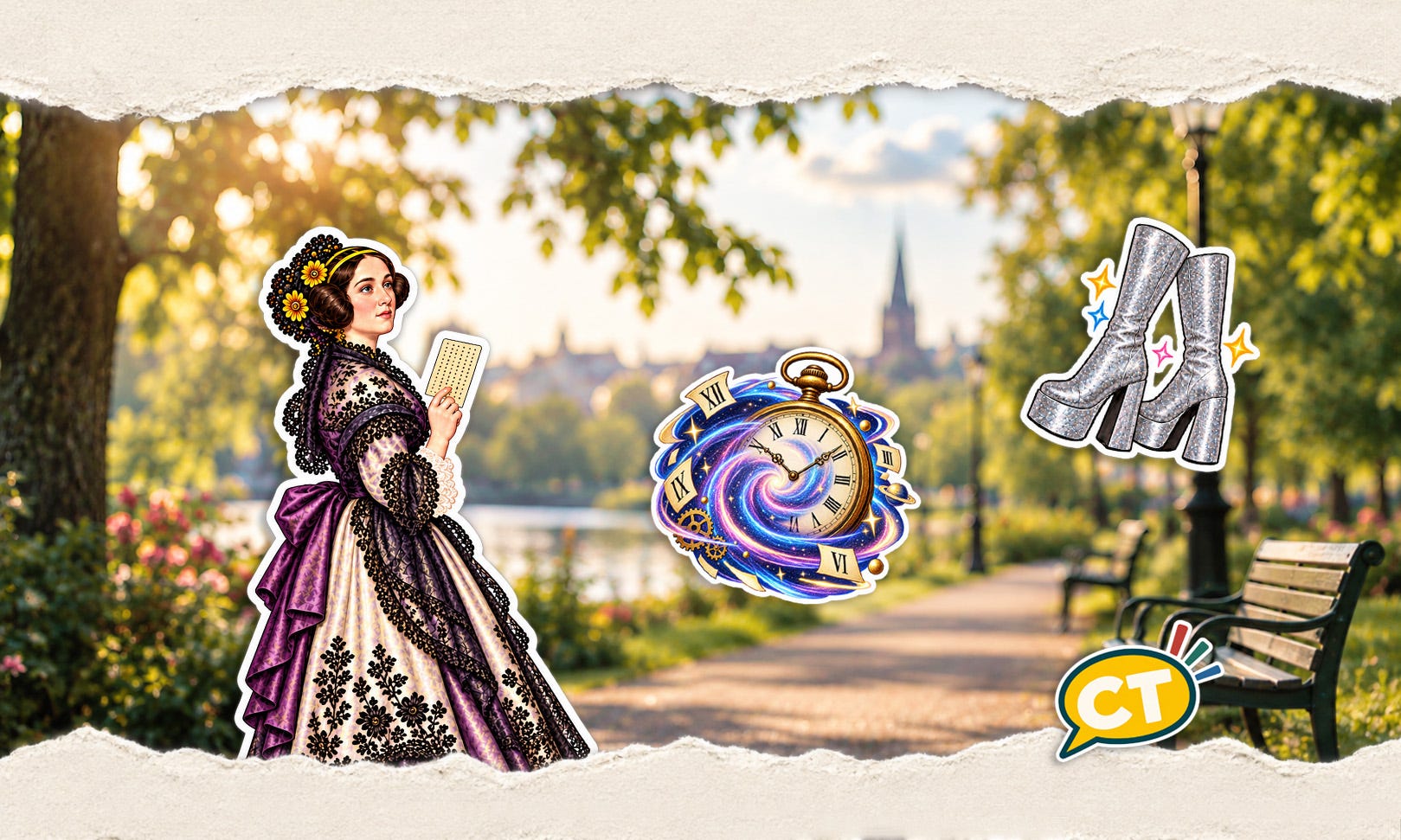
A lot of you found your way to Cultural Tendencies through Jodi Taylor and Jodi Taylor Books. So this one is for you — and everyone else who enjoys a slightly unhinged cultural adventure through time.
Don’t worry if you haven’t read Jodi Taylor’s books yet. Right now, the only thing you need to know is that there are five general rules of time travel:
Don’t change the past. (Bad. You may turn out to be your own father.)
Don’t go to the future. (Risky. You never know what you will find.)
Don’t be in two places at the same time. (Very bad. God knows what will happen.)
Don’t ever call it “time travel” in the company of Dr Bairstow. (Very, very bad.)
Don’t do it. Don’t even think about it. Period. (Unless you want to spend spectacularly low-quality time with the Time Police.)
Today, I will break the first three rules. Worse, I will encourage you to do the same in the comments.
Let’s go!
Rule 1: Don’t change the past.
This one is tricky. Even if you really tried to tiptoe through the past, you would probably still be stomping through the tulips of history. Time is a big puddle. Touch it anywhere, and the ripples will spread everywhere. Sneeze, scare a horse, and suddenly it’s your fault that someone who should go on to be the ancestor of half of Denmark is dead. Even if future Denmark doesn’t realise that half of the population is missing, it will mess things up.
It’s tempting to take out a few of history’s most rotten apples. The problem is that if you take one person out, another will inevitably step forward – like a fresh shark tooth replacing an old one. Also, anyone – good or bad – might turn out to be the ancestor of an alarming number of people.
In 2003, a group of scientists claimed that many millions of Asians were descendants of Genghis Khan. Today, their science is contested, but still. Over time, anyone can rack up hordes of ancestors.
Even if you’re okay with breaking the first rule of time travel, taking people out is very risky. But what about nudging history ever so gently? You could, for instance, give someone an opportunity they didn’t have in the original timeline. One carefully amplified bright mind could potentially do more good than one nasty voice silenced. And history is filled with bright minds. If you could give them a hand, would you?
I often think of Ada Lovelace. Being the daughter of the “mad, bad, and dangerous to know” Lord Byron made her both privileged and unfortunate. In an attempt to keep her away from the dangerous world of her (in)famous and absent father, her mother forbade her to read poetry and instead pushed her towards safer pursuits like mathematics.
This turned out to be lucky. Ada had a brilliant mathematical mind. In 1843, at only 27, she wrote what is considered the world’s first computer program. An impressive feat, especially since another century would pass before a machine capable of running it existed.
What if Lovelace had had access to a computer? A mind like that, armed with modern tools? I think she would have changed the world.
If nothing else, it may have saved us all from one of Sweden’s most embarrassing displays of chauvinist stupidity. In 2014, the local government of Lund, a university town in southern Sweden, had a brainwave: name a local park Lovelace Park in honour of Ada Lovelace. This immediately sparked a debate that revealed the limited cultural references of a disturbing number of people. It went something like this:
“You can’t name the park after a porn star!”
“We are not naming the park after Linda Lovelace of Deep Throat fame, but after Ada Lovelace of mathematical genius fame.”
“People are going to call it the porn park!”
“Ada Lovelace was a mathematical genius.”
“THE PORN PARK!”
I don’t know what happened to the park. It’s not on Google Maps, which makes me suspect stupidity won this one. The horror! The horror! Unfortunately, brilliance is overshadowed by ignorance every day. Let’s do our utmost to break that depressing downward spiral.
If I could go back in time, I’d give Lovelace a laptop and then head back to a new today where – hopefully – a female mathematical genius could no longer be ignored just because she happened to share a name with a porn star.
Rule 2: Don’t go to the future.
This one is particularly hard for me. I’m not afraid of dying – I’m afraid of missing out. It’s a condition I call FOMO Mortis. The problem with being a history buff is that you will always know an awful lot more about the past than you ever will about the future – especially the part that will unfold after your death.
You may not be thinking of the Roman Empire every day (as a surprising number of men and I do). But you only need to have a vague idea that Caligula was a bad chap to know way more about ancient times than you will ever truly know about the day after your death. You can make educated guesses, but nothing more. The day after your death may look exactly like the day before ... or a meteor hit the planet, and we’re all in the great beyond being chased by dinosaurs. Who knows?
The part after your death is inevitably a massive chunk of time. It’s infinite. I’m a very curious person. I don’t like not knowing things for five minutes, much less so for an eternity. So, this bugs me. If I were to time-travel, I’d like to jump around the future in all its many iterations. The near future, the not-so-near, and the very far-off one.
My expectations as far as humankind is concerned are not high at the moment, but still. There will be a future of some sort. I’d like to know what it will look like. Don’t you?
Rule 3: Don’t be in two places at the same time.
I understand this rule to be mostly about personal safety hazards, so I’ll be a bit selfish about this one. Still, I would only risk breaking it for something momentous - like ABBA. I’d go straight to the Nippon Budokan in Tokyo on March 27, 1980, and thoroughly enjoy myself at ABBA’s very last live concert.
Being Swedish has nothing to do with it. I was born in 1974, just three days after ABBA won the Eurovision. Back then, Swedish people were too busy writing songs about hating ABBA to realise what they were missing. In the 80s, I was bullied in school for listening to ABBA. It wasn’t until the early 90s – when ABBA Gold was first released – that the Swedes finally caught on to the hype. I guess it’s hard to be a prophet in your own country.
I don’t care that Spotify thinks I’m twenty years older than I actually am, because of my ABBA-heavy streaming statistics. I love ABBA. They have always been – and still are – the soundtrack of my life. Happy? Listen to ABBA. Sad? Listen to ABBA. So far, nothing has happened to me that could not successfully be accompanied by an ABBA song. I love them so much, I even forgive them for triggering my pet peeve by using children’s choirs. Twice... Brrr...
And now you know enough about me to fully comprehend my horror at the following little story from real life.
A while back, I was in the town of Jönköping to give a talk about cultural politics. Afterwards, a local journalist wanted to talk to me. He asked a few questions about my talk. Then he asked what I knew about Jönköping’s local culture. Embarrassingly, not much. I blurted out that Agnetha (the blonde in ABBA) is from Jönköping. He sighed and said, “Yeah, yeah, but I meant REAL culture.” Gasp! The ground shifted under my feet.

If I had had any pearls, I would have clutched them. Vigorously. It’s like asking someone about the local culture of Nashville, getting the reply “Dolly Parton” and then going: “Yeah, yeah, but I meant REAL culture.” Double gasp!
Now it’s your turn!
Time-travel rules exist to keep us from breaking reality — but imagination doesn’t care about rules. It thrives when we bend them, twist them, and run full speed into their contradictions.
So, what do you say? If you could nudge the past, peek into the future, or appear twice in the same Tuesday afternoon — what would you do?
We’re all weirdos here. Don’t hold back.
