


I’ve shared a fair amount of tears with
strangers on the internet this week. The strangers? Quite the motley bunch. A drag queen from Berlin, a MAGA dude from Alabama and everyone in between. Dolly Parton died, and somehow our differences seemed very small indeed next to our shared loss.
A few years ago, I also shed tears aplenty with strangers online. ABBA had released their first new music in forty years. Suddenly, a grandmother from Brisbane, a twenty-year-old twink from Brighton and I seemed to be having some sort of simultaneous and glorious emotional emergency caused by pure happiness.
This is all very out of character for me. I’m quite private. I do not cry with strangers. Except that sometimes I apparently do. And apparently so do they. Sad tears. Happy tears. All unexpectedly public. All quite refreshing. Why?
How to disturb the universe
Humans are notoriously bad at reaching out to each other even when standing in the same room. We’ve all felt like T. S. Eliot’s J. Alfred Prufrock at a party. We’ve felt awkward, worried about our hair, and feared others' judgement. Walking over to break the ice with a stranger may indeed feel like we’re about to disturb the universe.
Just like Prufrock, we often struggle to find the right words. We are all stuffed to the brim with thoughts and feelings, and yet we fail to get them across to others. It makes us feel lonely. Misunderstood.
The irony is that Prufrock is not alone at all. We are all with him. He just never got the memo.
I always think of this when I watch the Doctor Who episode where the Doctor brings Vincent van Gogh to a modern gallery to show him what his paintings would come to mean to people. Van Gogh didn’t get the memo in his lifetime either. But culture can outlive its creator and go on reaching people long after they’re gone.
For all our difficulties connecting face to face, we have come up with a remarkably effective workaround: culture.
Hello, aliens. Here’s Beethoven
Apparently, we trust this workaround so much that we have even tried it on aliens.
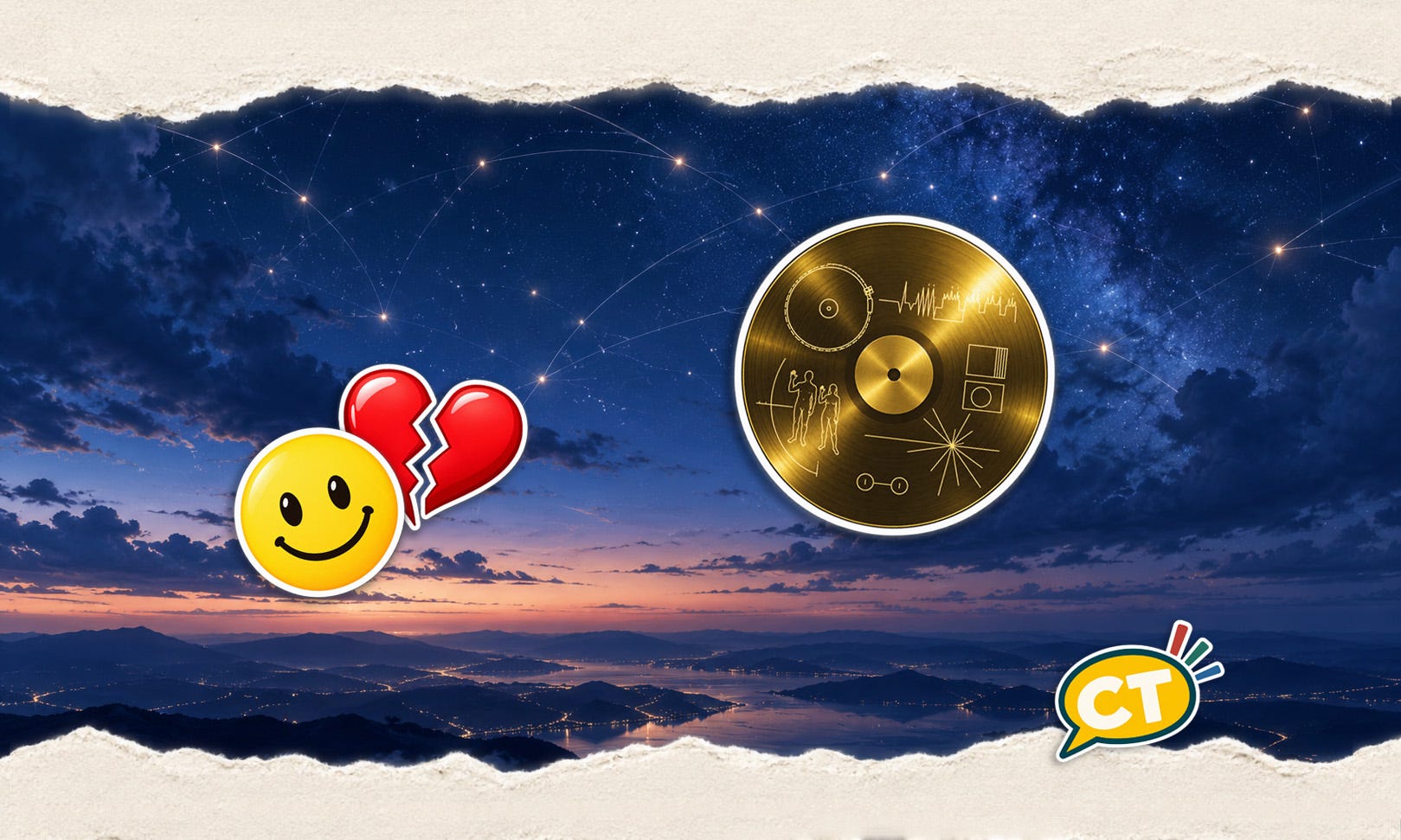
In 1977, NASA launched Voyager 1 and Voyager 2, each carrying a Golden Record with a message from humanity to whoever might one day find it. Among the greetings, images and sounds of Earth was a 90-minute interstellar playlist, ranging from traditional music from around the world to Beethoven’s Fifth Symphony and Chuck Berry’s Johnny B. Goode.
You would have to be a pretty stuffy alien not to shake your booty to that.
Unfortunately, NASA also included a pulsar map that can be used to locate our Solar System. If only The Three-Body Problem had been published by then. You really don’t want the first reply from outer space to be an ominous “We know where you live.”
When the switchboard lights up
But culture has another trick up its sleeve. It doesn’t only connect us to the people who made it. Sometimes the people it reaches find each other too. And that brings me back to Dolly, ABBA and all those tears.
Over decades, the music of Dolly and ABBA had worked its way into millions of lives – including mine. Most of the time, we carried those connections privately: doing the dishes, at the gym, at weddings, at funerals, at parties, belting along in the car.
Then something happened. Dolly died. ABBA came back. And suddenly the whole switchboard lit up. The internet didn’t create those connections. It just let us see them.
The MAGA dude from Alabama and I still don’t share a worldview. Maybe the grandmother in Brisbane and the twink in Brighton don’t either. Not even Dolly and ABBA can override human free will.
But they had quietly wired us into the same switchboard over the years. When it lit up, there we all were. Somehow.
It won’t stay lit forever. But maybe one or two lights will.
I no longer think I’ve been crying with complete strangers online.
