

Culture really packs a punch. Just look at one of my favourite poems, “Mrs Darwin” by Carol Ann Duffy:
7 April 1852.
Went to the Zoo.
I said to Him—
Something about that Chimpanzee over there reminds me of you.
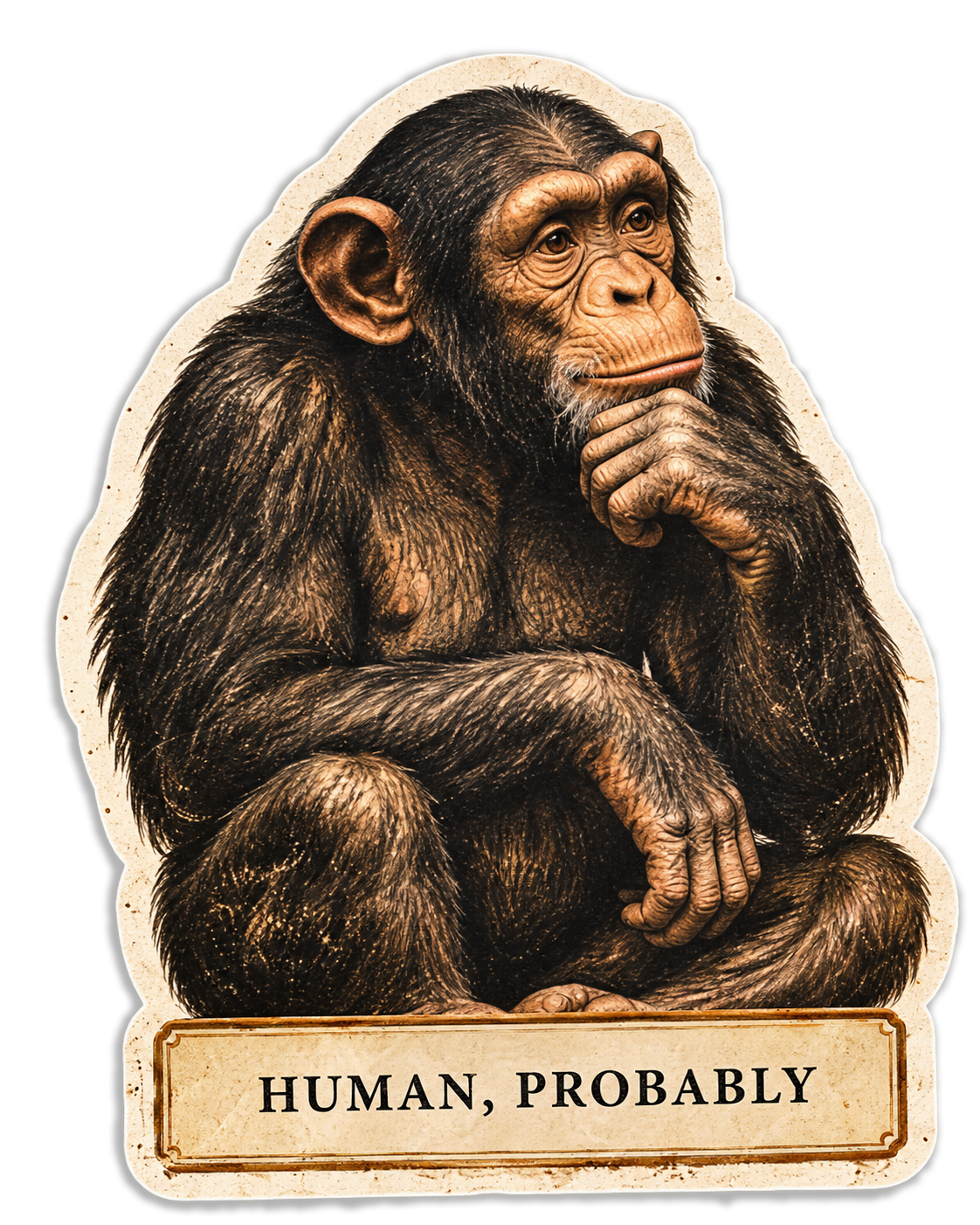
There’s the obvious gag: “Ha, hubby looks like an ape!” But lurking inside is so much more: the theory of evolution, a Victorian marriage, and the tedious tradition of women quietly noticing things that men become famous for. Just four lines and a chimpanzee become a veritable cultural Tardis.
There! I did it again. I only had to write Tardis. Even if you know very little about Doctor Who, you probably know what I mean: something unassuming on the outside and impossibly large on the inside. A single word did the heavy lifting of an entire paragraph.
Duffy’s poem is short, but it’s still a few sentences. This made me curious about how much meaning culture can zip into one file.
How small can we go?
About ten years after Mrs and Mr Darwin went to the zoo, Victor Hugo somehow found time between his many, many brothel visits to write the mighty 1,200-page tome Les Misérables. In the novel, Jean Valjean gets the prison number 24601. It’s mentioned only twice, but boy did that number travel.
It bided its time until 1985, when the English-language production of the musical Les Misérables opened in London. 24601 was suddenly being belted out onstage every night. Before long, it was belted out on stages and on screens all around the world.
The number was no longer a minor detail in Hugo’s novel. It had become Jean Valjean’s fate – injustice, punishment, and redemption – compressed into five digits.
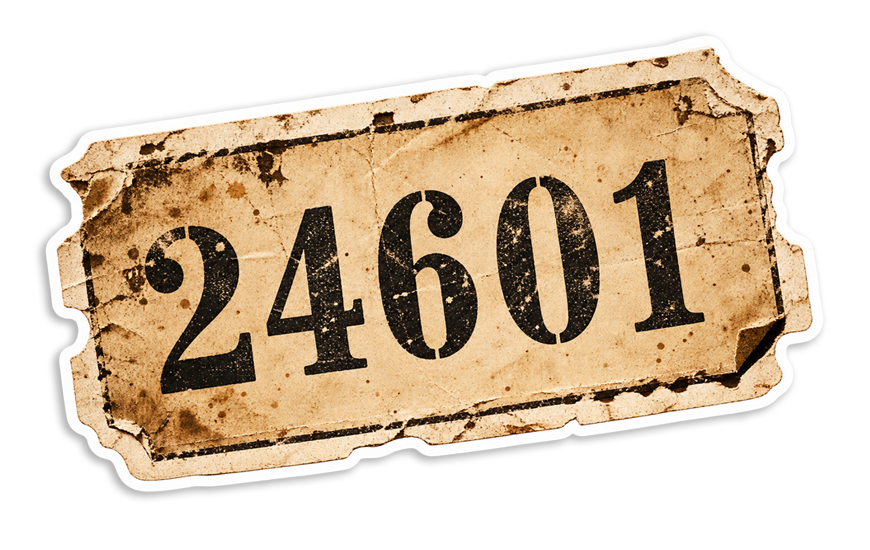
It also became a joke. Popular culture quickly began handing out 24601 to its own prisoners. Sideshow Bob got it in The Simpsons. Oscar Bluth got it in Arrested Development. Neither is any Jean Valjean, but both would undoubtedly argue the point at considerable length.
But what if we drop a digit? How much can culture pack into four? Quite a lot, it turns out.
Say 1984, and you’ve instantly compressed an entire political system into a handy bite-sized package that most people can decode.
It barely matters whether the person you’re speaking to has actually read George Orwell’s novel. Politicians invoke the number regularly. My postman recently invoked it when he had to ask for my digital signature before handing over my beloved new coffee maker.
Then there is the fact that we lock fame-hungry strangers inside a house, film them around the clock, and call the programme Big Brother. Orwell didn’t predict that, but television knew that invoking him would explain the concept instantly.
Four digits were still two too many for Douglas Adams.
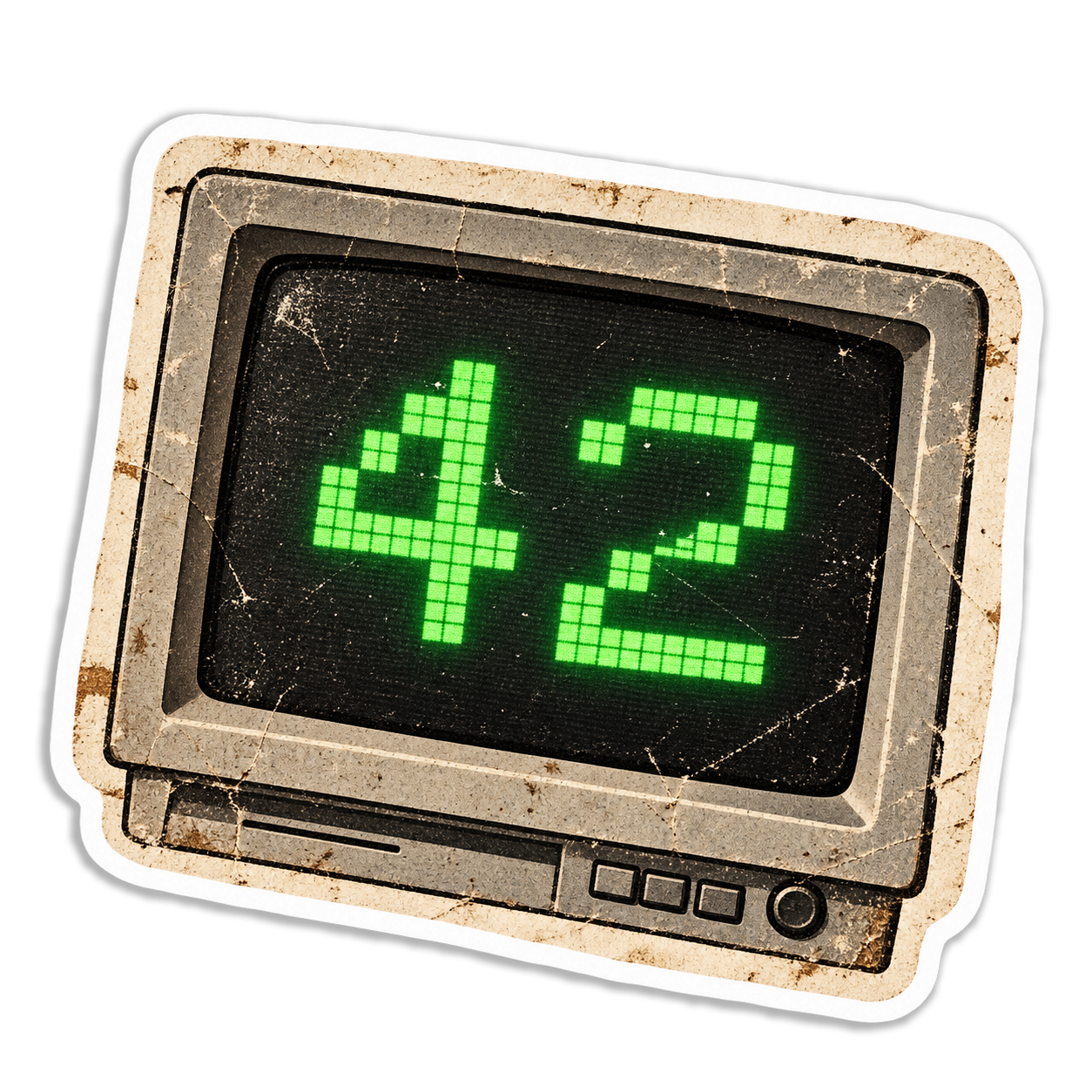
In The Hitchhiker’s Guide to the Galaxy, he tasked the supercomputer Deep Thought with finding the Answer to the Ultimate Question of Life, the Universe and Everything. Seven and a half million years later, it spat out the result. 42.
The joke is that two digits cannot possibly contain life, the universe, and everything. Or can they? Ask people for the Answer to the Ultimate Question, and a surprising number will reply, “42.” There are T-shirts and mugs to prove it.
John Williams didn’t even need digits. He used notes.
Culture doesn’t only compress meaning. It compresses feeling too. You can try it yourself. While out swimming, slowly hum an E followed by a quick F. Your friends will tell you to stop. Repeat them a little faster, and they will tell you to stop with considerably more urgency.
Williams loaded those two notes with deep, dark water, danger lurking below, and the prospect of something really nasty nibbling your feet off. You don’t need to remember the whole plot of Jaws. You don’t even need to see the shark. Your body instantly knows that your chances of reaching the beach have decreased dramatically.
Once again, a tiny piece of culture turns out to have enormous teeth.
Same trick, darker cargo
Unfortunately, culture can be a bit of a bastard. The compression doesn’t come with a moral compass. Culture doesn’t care what it smuggles into your head. And it really doesn’t care what it detonates in there.
A mischievously humming friend can fill me with a sense of impending doom and make me flee head over heels from a perfectly shark-free swimming pool. A racial caricature or a homophobic trope can carry an enormous historical load of bias. Cultural malware can trigger hostility before critical thinking has even taken its coat off.
Sometimes it happens by accident. Other times someone knows exactly what they’re doing. I’ve worked in marketing. I know how difficult it is to get a message through to someone who isn’t already listening. If you tap into something familiar, it’s much easier to sneak past their defences.
Villains are a great example. The cultural shorthand for villainy often involves someone who is “wrong” in some way. Men become effeminate and flamboyant. Women are masculinised or made conventionally ugly. Foreignness, scars, and physical deformity have all been pressed into service in the villain department.
Being a short-haired lesbian with some scars, I obviously object to this sloppy cultural shorthand. We’re not all that evil. But combine attributes like these with moral shortcomings often enough, and the shorthand starts working surprisingly well. Keep repeating the pattern, and eventually a single cue can summon the rest.
Storytellers everywhere have taken advantage of it. Shakespeare did it in Richard III, Ian Fleming in From Russia with Love, and Disney in The Lion King and Aladdin. It’s easy. Why go through the bother of showing the audience why someone is dangerous when you can say almost as much with a hunched back, a masculine woman, or a limp wrist?
Most of the time, this kind of shorthand is inherited. Often even unconsciously. But it’s also a wonderful opportunity for those who want to use it to further their own agenda. Say hello to propaganda.
The Nazis did not have to invent antisemitism from scratch. They could just reach into an existing cultural archive of stereotypes, then systematically drip-feed them back into the culture of the day. The audience already knew how to unpack the associations when they encountered them. The groundwork had already been done.
Today, this trick has acquired a turbocharger. Social media is fast and rewards compression. A single image can carry a whole worldview around the globe in an instant. Let’s have a closer look at the humble mugshot.
It used to signal disgrace, but popular culture has expanded its repertoire. Frank Sinatra made it glamorous. Jane Fonda made it defiant. David Bowie made it downright chic. By the time Donald Trump posed for his own in 2023, the mugshot was already packed with both rebellion and anti-establishment cool.
So, a picture that might once have ruined a political career became a remarkably effective marketing and fundraising opportunity. An image associated with prosecution was read as persecution by millions. One glowering face staring down the camera told a much larger story.
The cultural shorthand can be so familiar that red flags barely register. The reaction shortcuts the analysis. Nobody gets a special exemption. Sometimes the file opens on its own, and we have no clue we’re running the code.
Mind the gap, please
A lot of the stuff being transmitted to you is designed to trigger a reaction before reflection. That’s why dissecting a four-line poem about Mrs Darwin or pondering why two notes can make perfectly sensible people jump out of a swimming pool is time well spent.

A single word like “Tardis” releases an entire science-fiction universe in your head. But there’s a tiny gap between it landing and all its cultural luggage spilling out all over the place. To catch that moment, you need to know how the machinery works.
I was once tasked with pulling the levers to sell Paulo Coelho’s The Alchemist to Swedish booksellers, with little more than the fact that it was Madonna’s favourite novel at the time. It worked ridiculously well. Once you can spot the cultural machinery at work in the harmless stuff, you’ll get better at spotting it when the stakes are higher. If a political slogan pulls the same lever as the Jaws theme, you’ll know it’s time to pause and think.
William Blake wanted “To see a world in a grain of sand.” Culture does it all the time, and it can squeeze an entire surveillance state into my postman’s request for a signature. That’s part of the magic.
We may still flinch when a friend starts humming in the pool. That’s fine. The trick is to notice the flinch and scan the file for malware before we unpack it.
What’s your favourite tiny piece of culture that somehow contains an entire world?
Still feeling a bit culturally promiscuous?


